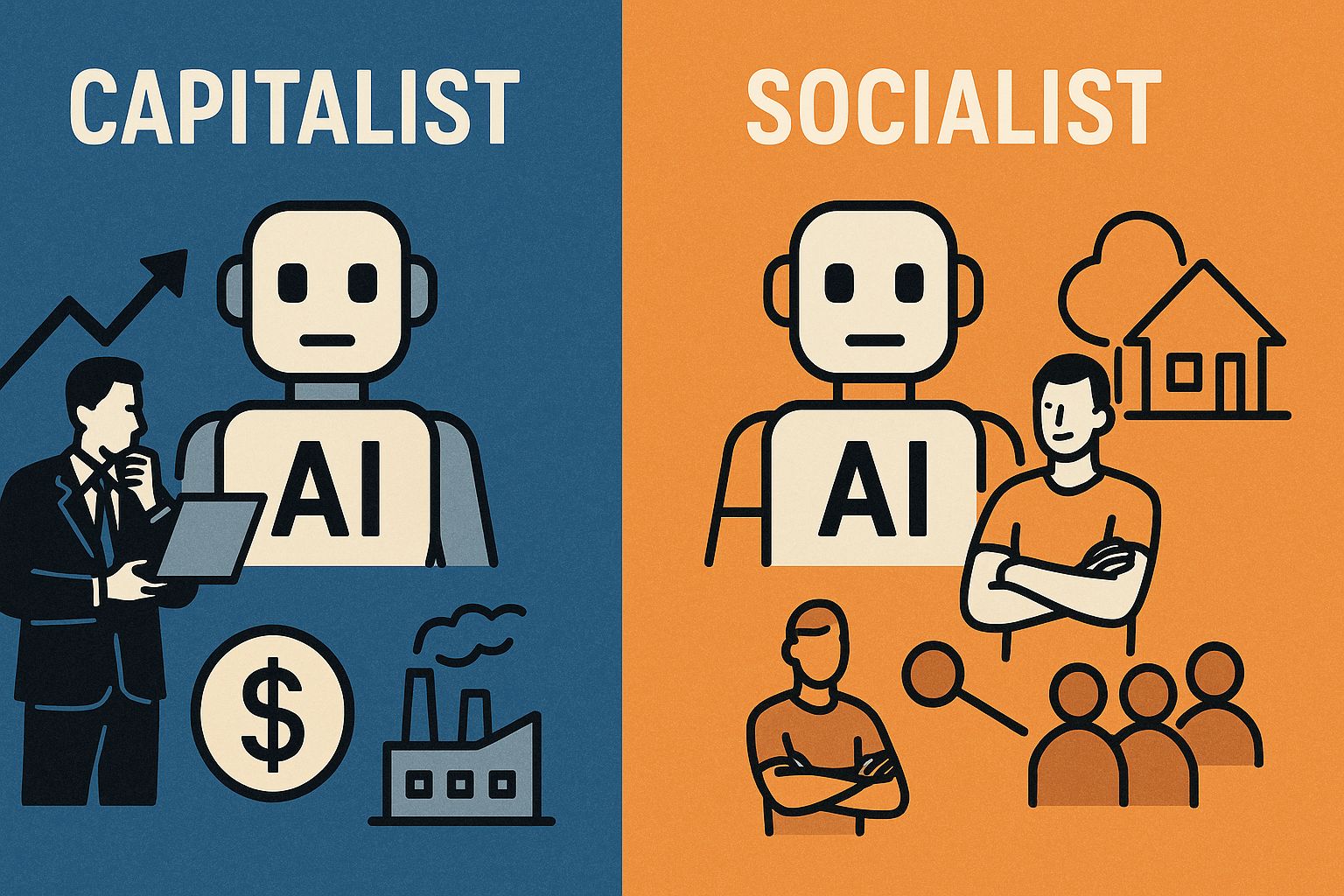
Artificial Intelligence (AI) is transforming how we work, live, and interact. But the way AI shapes the future will depend less on the technology itself—and more on the economic and social systems that govern it.
In this article, we’ll explore how AI could evolve under two competing ideologies: capitalism and socialism.
AI in a Capitalist System
Under capitalism, AI is viewed primarily as a tool for efficiency and profit.
- Business optimization: Companies can automate processes, reduce labor costs, and maximize output.
- Market expansion: AI creates new products, platforms, and industries, fueling economic growth.
- Competition-driven innovation: Firms race to out-innovate one another, accelerating technological advancement.
👉 However, capitalism may also concentrate wealth and power. The owners of AI systems—large corporations and investors—stand to benefit most, while workers face job displacement and widening inequality.
In short: AI in capitalism drives productivity and innovation, but risks deepening inequality.
AI in a Socialist System
In a socialist framework, AI is seen as a public good rather than a private asset.
- Automation for liberation: AI could take over repetitive and dangerous work, giving people more time for creativity and community.
- Universal access: Healthcare, education, and other essential services could be AI-powered and available to everyone.
- Democratic control: Data and algorithms would be managed collectively, ensuring transparency and accountability.
👉 The challenge is ensuring efficiency and innovation while avoiding bureaucratic stagnation.
In short: AI in socialism aims to increase equality and well-being, but may face scaling and incentive challenges.
Capitalism vs Socialism: Which Future for AI?
- Capitalism: Faster growth, higher innovation, but more inequality.
- Socialism: More equality, fair distribution, but potentially slower innovation.
The reality may not be purely one or the other. Instead, the future of AI will likely blend market incentives with public oversight.
Why This Matters
AI is not just about technology—it’s about values. The systems we choose will determine whether AI:
- Serves the few (shareholders, tech giants, elites), or
- Empowers the many (workers, communities, humanity as a whole).
Conclusion
Artificial Intelligence can either deepen inequality under capitalism or promote collective well-being under socialism. The question isn’t just what AI can do, but who it should serve.
As we move forward, societies must ask:
👉 Do we want AI to maximize profit, or to maximize human flourishing?
The answer will define not just the future of technology—but the future of humanity.
Frequently Asked Questions (FAQ)
1. How does AI affect capitalism?
AI strengthens capitalism by driving efficiency, reducing costs, and enabling companies to scale rapidly. However, it also risks concentrating wealth and widening inequality.
2. How does AI fit into socialism?
In socialism, AI is seen as a public good. It can automate repetitive work, provide universal access to services like healthcare and education, and ensure more equal distribution of benefits.
3. Which system benefits more from AI—capitalism or socialism?
Capitalism benefits from faster innovation and growth, while socialism emphasizes fairness and collective well-being. The most effective approach may be a hybrid that blends innovation incentives with social protections.
4. Will AI increase inequality?
If controlled by private corporations under capitalism, AI could worsen inequality. Under socialism or collective ownership models, AI could reduce inequality by making resources more accessible.
5. What is the future of AI in society?
The future of AI will depend on governance. It could either deepen divides under profit-driven systems or create more inclusive societies if developed with equity and public benefit in mind.